


GILLIAN ILES' GLORIOUS CATASTROPHE MAPS THE EMOTIONAL GEOGRAPHY OF PRECARITY
- 2 days ago
- 3 min read

Review by Rebeccah Love
'Glorious Catatrosphe' on unti June 13
Koffler Arts 180 Shaw St
Four years ago I began hosting dinner parties with a conversational focus on the housing crisis. I invited architects, architecture professors, real estate agents, urban planners, and housing startup CEOs. Over time, these conversations expanded and intensified, culminating in a large dinner last summer with Toronto’s Chief City Planner, where we discussed laneway houses, zoning laws, and the larger abstractions at play that are quietly creating havoc in the city’s attempt to keep a roof over everyone’s head.
I am an independent filmmaker and arts journalist whose professional world has very little to do with what I call “City Questions.” And yet I find I return to them anyway. A long time ago, maybe 15 years, while struggling with manic depression, at rare moments I would feel a strange impulse to abandon structure altogether, like the idea of pitching a tent in a park just to write myself into another world, in the spirit of Orwell’s Down and Out in Paris and London. These moments are brief and always pass, but they leave a persistent sensitivity to anything that touches shelter, exposure, and survival. That sensitivity may also be what first drew me to hosting salon-style dinners, a need to understand, in a more structured way, the questions that continued to haunt me.
I carry with me that history of sensitivity when Koffler Arts invited me to see Gillian’s exhibition Glorious Catastrophe. Before visiting, I had been thinking about C.S. Lewis’ wardrobe as a kind of spiritual threshold, a portal into another order of reality. Stepping into the show felt not unlike that, Gillian graciously invited me into her own Narnia. The exhibition unfolded like an unusually articulate yet somewhat hypnagogic fever dream, a phantasmagoria activating what I can only describe as an internal psychogeographical spell.
The exhibition opens with a series of drawings and paintings rigged from the ceiling, mimicking roof trusses. They immediately establish a feeling of temporary structure, shelter that is both present and unstable. There is a quiet but powerful reference here to Toronto’s unhoused communities and the precarious architectures of survival they create. The work doesn’t illustrate these conditions so much as echo them, pulling the viewer into a shared emotional register of fragility and invention.
After passing through these visions of precarity, we land in an open terrain divided in two. The experience becomes immersive in a way that is difficult to describe without sounding excessive, yet it was genuinely disorienting in the best sense, shifting the gallery into an alternative moral and psychic terrain. This was made even more vivid by the artist’s presence, guiding me through the landscape with an unusual warmth that stayed with the work.
The geographies are painted and projected onto housewrap, delivered in tall continuous rolls. Installed across the space, it creates a panoramic, immersive field that heightens the sense of constructed illusion within the painted environment.
The central geographies of the show turn on the politics of looking. In the first half, the viewer is placed in a position of exposure, as prey, surrounded by elements of domestic comfort that are interrupted by concealment and surveillance, as if targeted by unknown hunters behind blinds. In the second half, the position shifts, the viewer becomes the one who looks, the one with relative control. Across both spaces, we surrender on both sides to the power and even violence of the gaze.
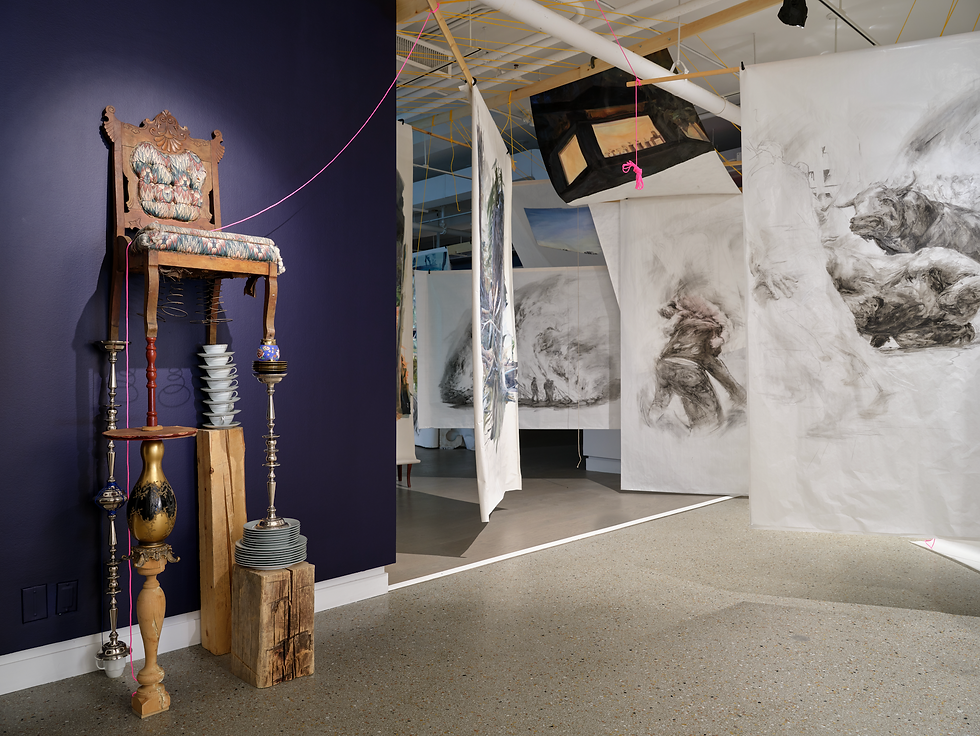
My emotional experience of the exhibition was so strong it felt dreamlike, touching archetypes and images from my own interior life. In my own life, I have often felt caught in a tug between different power structures, between stability and collapse, containment and escape, and Gillian’s work seemed to give spatial form to that tension, without resolving it into explanation. It assembles loosely connected but strangely precise fragments into what feels like a thesis on beautiful devastation. It is, at times, terrifyingly articulate in how it conjures instability without fixing it into explanation.
Leaving the show, I kept thinking about the precarious structures that haunt both our cities and our private imaginations. This is a work that speaks to the realities unfolding in Toronto’s parks and shelters, but also to the quieter architectures we carry inside ourselves. It remains one of the most affecting exhibitions I have experienced in recent years.
For more information or to follow more Koffler Arts shows please visit kofflerarts.org
Comments